


Big Bag Sizes: Full Characteristics Table

A correctly chosen big bag size is a balance between efficient volume use and cargo safety. A container that is too small risks overloading and tearing, while one that is too large wastes space during transportation and storage. This article compiles standard big bag sizes, a formula for calculating the required volume, and a bulk density table for common materials.
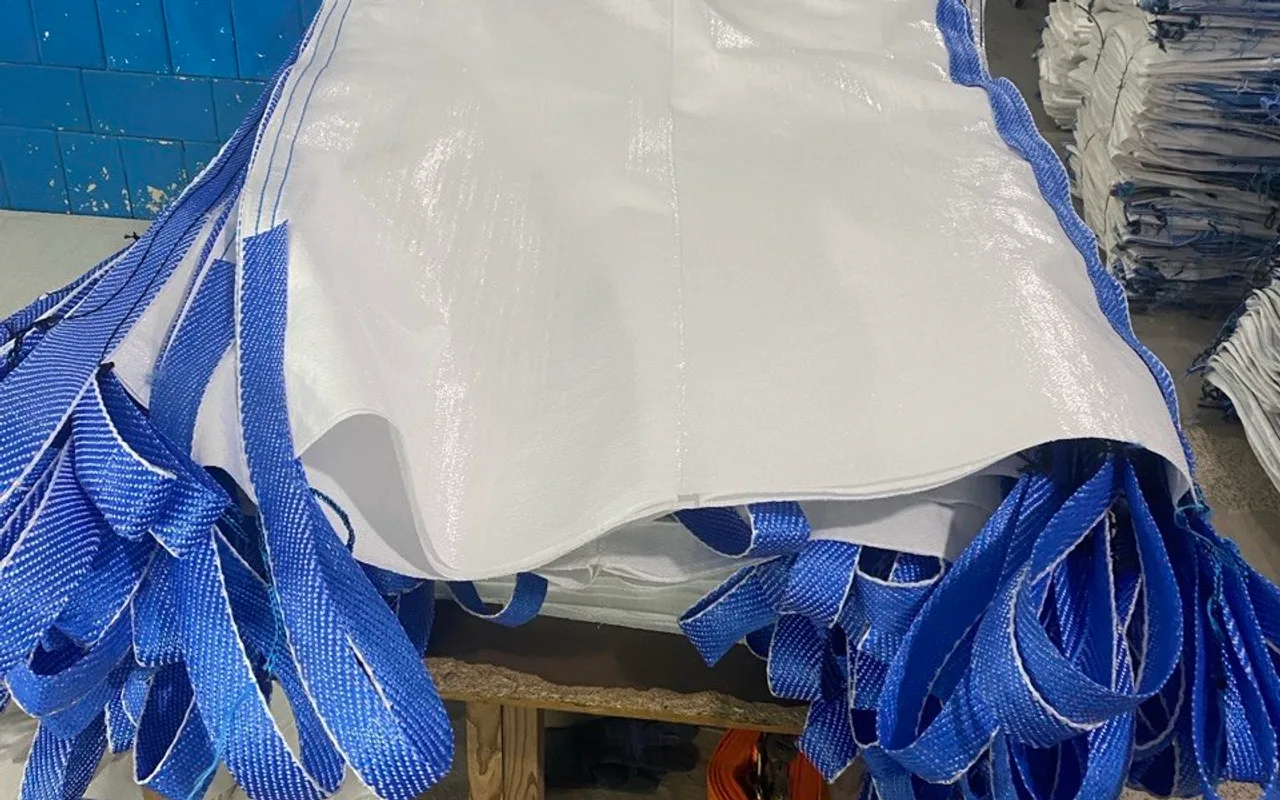
Standard Big Bag Sizes by Load Capacity
Below are typical parameters of big bags produced in Ukraine. Dimensions may vary depending on the manufacturer and specific configuration (number of loops, presence of spouts).
| Load Capacity | Dimensions (L×W×H) | Volume | Tare Weight | Application |
|---|---|---|---|---|
| 500 kg | 75 × 75 × 100 cm | ~0.56 m³ | 1.5–2.0 kg | Grain, compound feed, light powders |
| 750 kg | 85 × 85 × 120 cm | ~0.87 m³ | 2.0–2.5 kg | Fertilizers, pellets, granulate |
| 1000 kg | 90 × 90 × 130 cm | ~1.05 m³ | 2.5–3.5 kg | Wheat, sugar, salt, sand |
| 1250 kg | 90 × 90 × 150 cm | ~1.22 m³ | 3.0–4.0 kg | Crushed stone, coal, ore |
| 1500 kg | 95 × 95 × 150 cm | ~1.35 m³ | 3.5–4.5 kg | Cement, slag, building materials |
| 2000 kg | 100 × 100 × 165 cm | ~1.65 m³ | 4.5–5.5 kg | Sand, crushed stone, heavy bulk |
| 2500 kg | 105 × 105 × 175 cm | ~1.93 m³ | 5.5–6.5 kg | Ore, concentrates, minerals |
| 3000 kg | 110 × 110 × 180 cm | ~2.18 m³ | 6.0–7.0 kg | Heavy industrial materials |
* Data is approximate. Actual dimensions depend on the design (2- or 4-loop), top/bottom type, and fabric density. Most manufacturers produce custom-sized big bags according to the customer's specifications.
How to Calculate the Required Big Bag Volume
The main formula for size selection is: V = M ÷ ρ, where V is the required volume (m³), M is the cargo mass (kg), and ρ is the material's bulk density (kg/m³).
Example: you need to transport 1000 kg of wheat. The bulk density of wheat is about 750 kg/m³. Calculation: 1000 ÷ 750 = 1.33 m³. We choose a big bag with a volume of at least 1.35 m³ — this is the 95×95×150 cm model (1500 kg load capacity). Volume margin is 1.5%, load capacity margin is 50%. This approach guarantees safe operation.
A typical mistake is choosing a big bag solely by load capacity, ignoring the volume. A light material with low bulk density (e.g., wood shavings ~150 kg/m³) will fill the big bag long before reaching its weight limit. Conversely, a dense material (cement ~1500 kg/m³) will take up little space but quickly exhaust the load capacity limit.
Material Bulk Density Table
Use this table to calculate the required big bag volume:
| Material | Bulk Density | Big Bag for 1 Ton |
|---|---|---|
| Wheat | 750 kg/m³ | 90×90×150 cm (~1.22 m³) |
| Corn | 720 kg/m³ | 90×90×150 cm (~1.22 m³) |
| Granulated sugar | 800 kg/m³ | 90×90×150 cm (~1.22 m³) |
| Rock salt | 1200 kg/m³ | 90×90×130 cm (~1.05 m³) |
| Cement | 1500 kg/m³ | 85×85×120 cm (~0.87 m³) |
| River sand | 1600 kg/m³ | 85×85×120 cm (~0.87 m³) |
| Fertilizers (NPK) | 900 kg/m³ | 90×90×150 cm (~1.22 m³) |
| PE granulate | 550 kg/m³ | 100×100×165 cm (~1.65 m³) |
| Coal | 600 kg/m³ | 100×100×165 cm (~1.65 m³) |
| Wood chips | 250 kg/m³ | 110×110×180 cm (~2.18 m³) |
Sizes of Two-Loop and Four-Loop Big Bags
The number of loops affects not only the load capacity but also the container's dimensions:
Two-loop (2 loops)
Typical sizes: 75×75×100 — 90×90×130 cm. Load capacity up to 1000 kg. More compact, cheaper. Suitable for light and medium bulk materials. Less stable when stacked.
Four-loop (4 loops)
Typical sizes: 90×90×130 — 110×110×180 cm. Load capacity up to 3000 kg. Maximum stability. Suitable for stacking. Mandatory for heavy materials.
Rule of thumb: if the load exceeds 1000 kg or the big bags will be stacked, choose a four-loop option. For single-trip transport of grain or compound feed up to 1000 kg, a two-loop container is a rational choice.
Custom Sizes
The standard range covers most tasks, but there are situations when an atypical size is needed: a narrow big bag for limited space, an elongated one for large-volume light materials, or a square one with exact dimensions for pallet format. Most Ukrainian manufacturers, including 'UKRBAGPAK' LLC, produce big bags according to customer drawings. The minimum batch for custom sizes is usually from 50 units.
Frequently Asked Questions
Looking for a reliable supplier? UkrBagPak is a Ukrainian manufacturer since 2014. Buy big bags wholesale from the manufacturer directly, without intermediaries. 150+ FIBC models in stock: 2- and 4-loop, with valves, liners, from 500 to 3000 kg. ISO 21898 certified, 1-day shipping across Ukraine.
How many cubic meters are in a 1-ton big bag?
A standard 1000 kg big bag (90×90×130 cm) has a volume of approximately 1.05 m³. For materials with low bulk density (grain, granulate), a larger big bag with a volume of 1.2–1.35 m³ may be required.
How many tons does a big bag hold?
From 0.5 to 3 tons depending on the model. The most popular format is 1 ton (1000 kg). For heavy industrial materials, 2–3 ton big bags with reinforced loops are produced.
What is the height of a 1000 kg big bag?
Typical height is 130 cm (excluding loops). With loops, the total height can reach 170–180 cm. The exact height depends on the design and manufacturer.
Can I order a custom-sized big bag?
Yes, most manufacturers produce big bags according to customer's custom sizes. The minimum batch is usually from 50 units.
The most popular size on the market is 1000 kg — it covers about 70% of use cases. Buy a 1000 kg big bag directly from our factory in Zhytomyr: four-loop design, ships in one business day, factory price with no middleman markup.