


What is a big bag: complete guide to FIBC flexible containers

A big bag is a large flexible container made of woven polypropylene, designed for transporting and storing bulk materials weighing from 500 to 3000 kg. The official name is FIBC (Flexible Intermediate Bulk Container). In Ukraine, the terms MKR (single-use flexible container) and simply 'big bag' are commonly used.
The first FIBC containers appeared in the 1960s in Europe for transporting industrial powders. Since then, the design has gone through dozens of iterations, quality standards (ISO 21898) have emerged, and the flexible container itself has become the primary packaging for bulk cargo in agriculture, construction, and the chemical industry. The reason for its popularity is simple: a big bag is 3–5 times cheaper than rigid packaging of the same capacity, lighter, more compact when stored, and fully recyclable. You can buy big bags directly from the manufacturer from UAH 200/pc — the UKRBAGPACK catalog covers 500–3000 kg models.
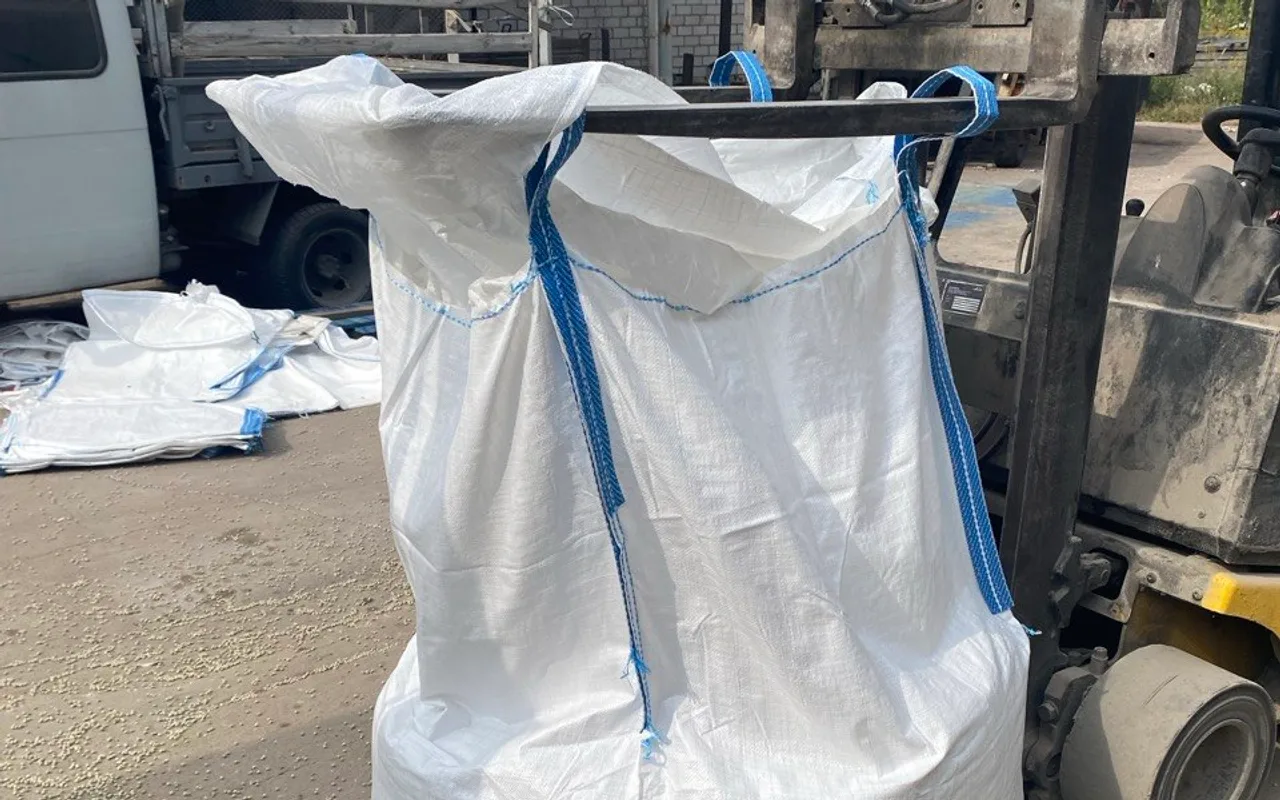
What a big bag consists of
Every FIBC flexible container has five main structural elements. Understanding its structure will help you correctly select the required type of big bag for a specific task.
Body
The main part made of woven polypropylene with a density of 160–230 g/m². The body holds the cargo and determines the overall strength of the container.
Loops (lifting straps)
2 or 4 loops made of polypropylene tape, sewn at the corners or sides. They are used to lift the big bag with a crane or forklift.
Top part
Can be open, with a filling spout, or with a skirt (duffle). Affects loading speed and moisture protection.
Bottom
Flat (closed) or with a discharge spout. A spout accelerates unloading on production lines.
Liner
An additional polyethylene bag inside the body. Protects contents from moisture and dust — mandatory for food and hygroscopic products.
For moisture-sensitive goods, we recommend ordering polyethylene liners separately or complete with a big bag. The liner is inserted inside the body and hermetically sealed, forming an additional barrier.
Classification by the number of loops
The number of loops is the first thing considered when choosing a big bag, as the loops determine the container's stability during lifting and the maximum load.
Two-loop
Two loops located on opposite sides. Suitable for loads up to 1000 kg. Lower cost, compact folding. Limitations: the container may deform during lifting, complicating stacking. Optimal for single-trip transport of sand, crushed stone, grain.
Four-loop
One loop on each corner — even weight distribution. Load capacity up to 3000 kg. The container retains its shape when lifted and is easily stacked. The standard for the chemical and food industries, where stability requirements are higher.
In practice, 4-loop big bags occupy about 80% of the market. Two-loop ones remain popular where packaging price is critical, and the cargo is transported once without stacking.
Classification by top and bottom design
The type of top and bottom directly affects loading and unloading speed and the degree of content protection.
Open top
Completely open neck. Fastest loading, but the contents are not protected from precipitation during outdoor storage.
Filling spout
A spout with a diameter of 35–50 cm that is tied after filling. Convenient for bulk materials, feeding from a hopper or silo.
Skirt (duffle)
A fabric cover that folds inward or outward. Protects from dust and moisture, suitable for outdoor storage.
Flat (closed) bottom
Completely closed — the simplest and cheapest design. Unloading is done by tipping or cutting.
Discharge spout
A spout at the bottom through which the contents pour out by gravity. Standard for production lines where dosed feeding is needed.
Bottom skirt
An additional layer of fabric covering the bottom seams and increasing strength. Used for heavy loads over 1500 kg.
Standard sizes and load capacity
The typical load-capacity range is 500 to 3000 kg; the most common format in Ukraine is the 90×90×130 cm big bag for 1000 kg with a volume of about 1 m³. Three base models for reference:
| Load Capacity | Dimensions (L×W×H), cm | Volume, m³ |
|---|---|---|
| 500 kg | 75 × 75 × 100 | 0.56 |
| 1000 kg | 90 × 90 × 130 | 1.05 |
| 3000 kg | 100 × 100 × 200 | 2.00 |
The full six-size range and rules for matching bag height to cargo bulk density are covered in big bag sizes: table and selection. Empty-container weight by design type and filled weight for 14 cargo types — in how much a big bag weighs.
The Safety Factor (SF) for standard big bags is 5:1 or 6:1. This means that a 1000 kg container can withstand a static load of 5000–6000 kg without breaking. SF 6:1 is recommended if the container is intended for reuse.
Application Areas
The FIBC flexible container is used in virtually every industry that requires the transport and storage of bulk materials. Here are the main directions:
In agriculture, big bags have replaced traditional 50 kg sacks: one 1000 kg container saves loading time by 15–20 times. In construction, big bags are convenient for delivering sand and crushed stone to sites without silo storage. The chemical and food industries choose big bags with liners and compliance certificates guaranteeing product purity and safety.
Advantages of big bags over other packaging
Let's compare the flexible container with its main alternatives:
- ✔Cheaper than barrels and rigid containers — the cost of one big bag is 3–5 times lower than a metal or plastic barrel of similar capacity
- ✔Lower tare weight — an empty big bag weighs 1.5–7 kg versus 15–25 kg for a barrel, reducing transport costs
- ✔Compact storage — empty containers fold and take up 10 times less space than rigid packaging
- ✔Faster loading — one big bag replaces 20 standard 50 kg sacks, reducing cargo handling time
- ✔Recycling — polypropylene is fully recyclable, unlike multi-layer packaging
- ✔Less dust during unloading — a closed spout allows contents to pour without spreading dust, critical for chemical and food production
- ✔Resistance to external factors — UV-stabilized polypropylene withstands outdoor storage for up to 12 months
Frequently Asked Questions
Looking for a reliable supplier? UkrBagPak is a Ukrainian manufacturer since 2014. Buy big bags wholesale from the manufacturer directly, without intermediaries. 150+ FIBC models in stock: 2- and 4-loop, with valves, liners, from 500 to 3000 kg. ISO 21898 certified, 1-day shipping across Ukraine.
What is a big bag in simple words?
A big bag is a large sack made of strong polypropylene fabric with loops for lifting by a crane. It is used for transporting bulk materials (grain, sand, fertilizers, chemicals) weighing from 500 to 3000 kg. Essentially, it is a single-use or reusable 'large bag' for bulk cargo.
How many times can a big bag be used?
It depends on the safety factor. Big bags with SF 5:1 are designed for single-trip use: they withstand a fivefold exceedance of nominal weight, but after the first 'loading-unloading' cycle, they do not guarantee full strength. Containers with SF 6:1 allow for multiple trips (usually 2–3 cycles) provided there is no mechanical damage or contamination.
What do MKR and FIBC mean — are they different?
They are synonyms for the same packaging. MKR ('soft single-use container') is the term common in Ukraine and CIS countries, while FIBC (Flexible Intermediate Bulk Container) is the international name from ISO standards. Manufacturers and suppliers use both names alongside the word 'big bag'.
Are big bags suitable for food products?
Yes, provided there is a certificate of compliance for contact with food products. Food-grade big bags are made of virgin polypropylene (no recycled materials), equipped with a polyethylene liner, and marked according to requirements. 'UKRBAGPAK' LLC produces containers with a full set of documents for storing sugar, flour, grain, and other products.
Now you know how FIBCs are designed. When choosing a supplier, look for FIBC big bags from the manufacturer in Ukraine — this lets you get the exact design you need without intermediary markups. UkrBagPak has been producing containers since 2014, ISO 21898 certified.