


How Much Does a Big Bag Weigh: Empty and Filled
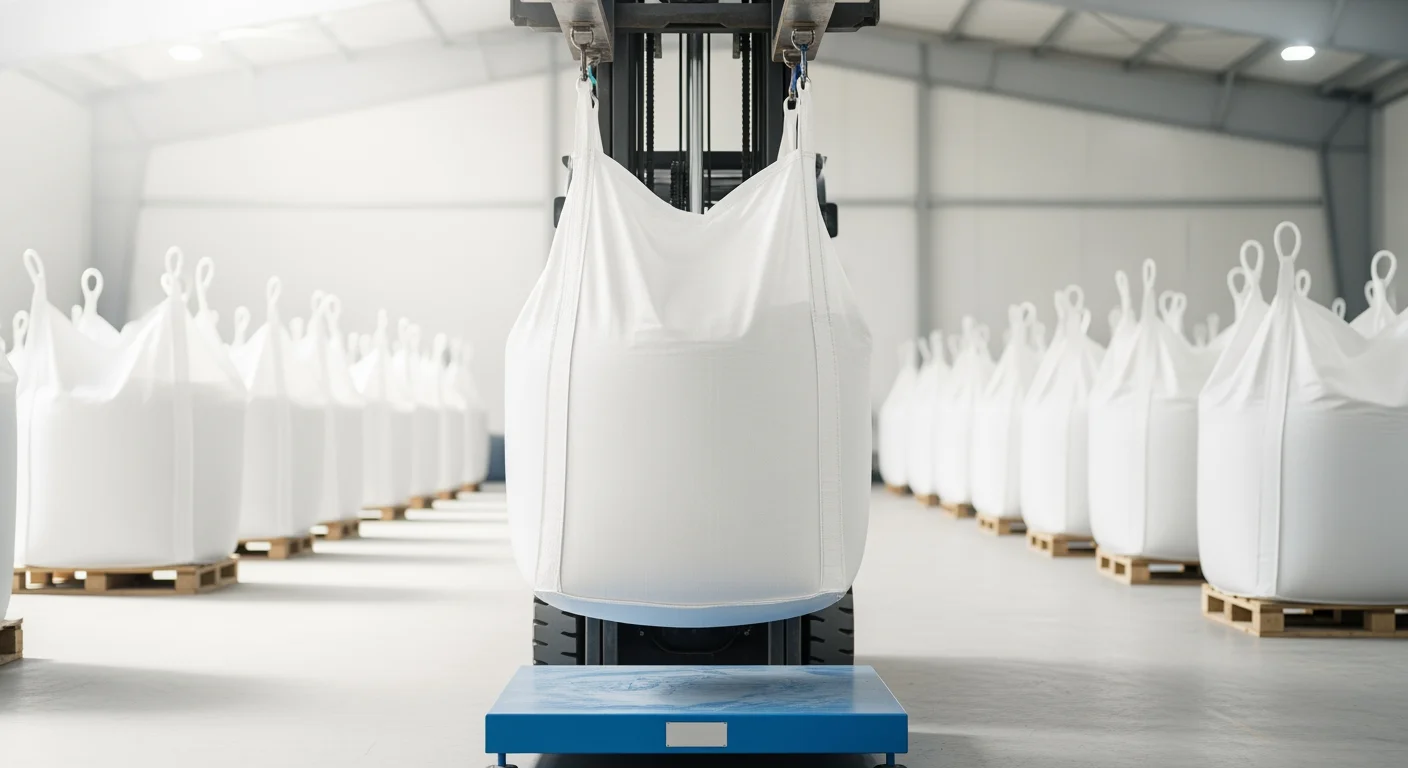
An empty big bag weighs 1.5 to 7 kg depending on size and fabric density. The weight of a filled container is set by the bulk density of the cargo: a standard 90×90×130 cm (~1 m³) big bag holds about 780 kg of wheat, 680 kg of pellets or only 260 kg of sawdust. Below are tables for 14 common cargo types and a simple calculation formula.
The weight question comes up in two situations: when calculating delivery costs for empty packaging, and when planning logistics for filled containers — how many big bags fit in a truck, railcar or container, whether the warehouse floor can take it, which forklift is needed. Let's cover both.
How Much an Empty Big Bag Weighs
The weight of an empty container depends on its dimensions, fabric density (160–220 g/m²), number of loops and presence of a liner. Reference values for standard sizes:
| Big bag size | Dimensions, cm | Empty weight |
|---|---|---|
| 500 kg | 75 × 75 × 100 | 1.5–2.0 kg |
| 750 kg | 85 × 85 × 120 | 2.0–2.5 kg |
| 1000 kg | 90 × 90 × 130 | 2.5–3.5 kg |
| 1500 kg | 95 × 95 × 150 | 3.5–4.5 kg |
| 2000 kg | 100 × 100 × 165 | 4.5–5.5 kg |
| 3000 kg | 110 × 110 × 180 | 6.0–7.0 kg |
A polyethylene liner adds 0.3–0.8 kg, lamination adds about 10% to the fabric weight. For batch delivery estimates: 500 empty 1000 kg big bags weigh roughly 1.5 tonnes and take 2–3 pallets.
Filled Big Bag Weight: Table by Cargo
The same big bag weighs radically differently with different cargo. The weight is determined by the bulk density of the material. The table shows the content weight of a standard 90×90×130 cm (~1.05 m³) big bag when filled to capacity:
| Cargo | Bulk density | Weight in a ~1 m³ bag |
|---|---|---|
| Dry sawdust | 0.20–0.30 t/m³ | ≈ 250–270 kg |
| Sunflower seeds | 0.40–0.44 t/m³ | ≈ 420 kg |
| Flour | 0.50–0.60 t/m³ | ≈ 550 kg |
| Barley | 0.60–0.65 t/m³ | ≈ 630 kg |
| Wood pellets | 0.60–0.70 t/m³ | ≈ 680 kg |
| Corn | 0.70–0.74 t/m³ | ≈ 720 kg |
| Urea | 0.70–0.78 t/m³ | ≈ 740 kg |
| Wheat | 0.75–0.80 t/m³ | ≈ 780 kg |
| Granulated sugar | 0.80–0.85 t/m³ | ≈ 830 kg |
| Ammonium nitrate | 0.80–0.90 t/m³ | ≈ 850 kg |
| Coal | 0.80–0.95 t/m³ | ≈ 900 kg |
| Cement | 1.10–1.30 t/m³ | ≈ 1200 kg ⚠️ |
| Crushed stone 5–20 | 1.35–1.45 t/m³ | ≈ 1450 kg ⚠️ |
| Dry sand | 1.50–1.60 t/m³ | ≈ 1600 kg ⚠️ |
⚠️ Important: for cement, crushed stone and sand, filling a 1000 kg big bag to the top exceeds the safe working load. These materials are filled to 60–80% of the volume, or shorter containers are used. Detailed guidance is on the big bags for sand and construction page.

How to Calculate the Weight of a Filled Big Bag
The formula is simple: Weight (t) = Bag volume (m³) × Bulk density of the cargo (t/m³). Example for barley:
- Volume of a 90×90×130 cm bag: 0.9 × 0.9 × 1.3 = 1.05 m³.
- Bulk density of barley — 0.62 t/m³.
- Content weight: 1.05 × 0.62 = 0.65 t, i.e. about 650 kg.
- Add the packaging weight (~3 kg) — total bag weight ≈ 653 kg.
The reverse task — how many bags a batch needs: 20 tonnes of barley ÷ 0.65 t ≈ 31 big bags. For any cargo and tonnage there is a calculator: how many big bags you need per N tonnes with tables for 10/20/50/100 t. For grain crops with per-crop tables see the big bags for grain page.
Why a Big Bag Must Not Be Overloaded
The rated capacity (SWL — Safe Working Load) includes a safety factor: SF 5:1 means a 1000 kg bag fails only at ~5000 kg in a lab test. That margin covers dynamic lifting loads, forklift jerks and fabric wear — not systematic overloading. Filling beyond the SWL fatigues the seams and can cause a failure during lifting — losing the cargo and endangering people. If your cargo is heavier than typical, simply order a bag with a higher SWL: the UKRBAGPACK catalog has models up to 3000 kg.