


Safe Big Bag Handling: Filling, Lifting, Stacking and Discharging
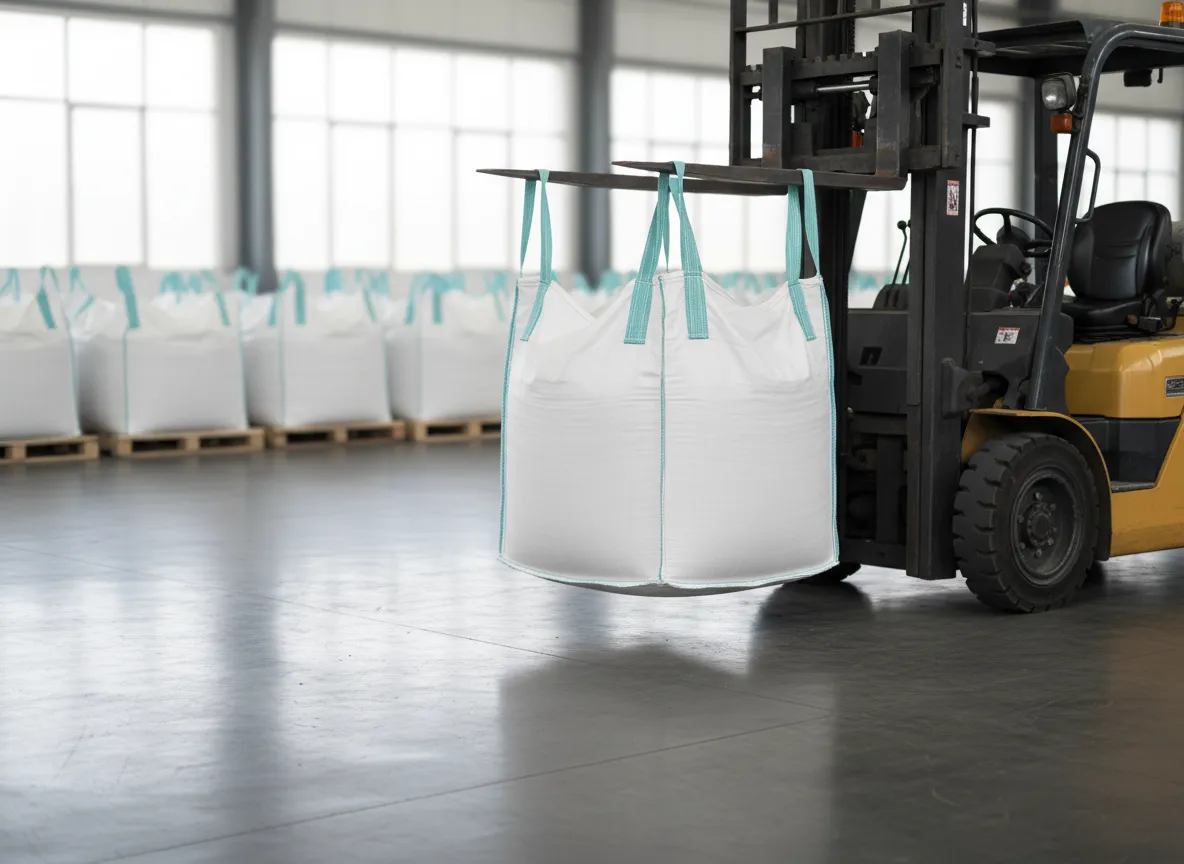
A big bag is safe as long as three rules hold: the load never exceeds the SWL on the label, the bag is lifted by all its loops at once (by forklift — two loops on each fork, by crane — through a spreader beam), and only 4-loop bags with a 6:1 safety factor are stacked in several tiers. Below is what to check and how to act at every stage, from filling to discharging and reuse.
What to read on the label before filling
The manufacturer prints the limits of safe use on the label. Before the first filling, check four items:
| On the label | What it means in practice |
|---|---|
| SWL, kg | The maximum load you may fill. Heavy materials reach it before the bag is full by volume |
| Safety factor 5:1 or 6:1 | 5:1 — one transport cycle; 6:1 — 2–3 full cycles with an inspection in between |
| Single-trip / multi-trip | A single-trip bag is not returned to service after discharge |
| Lifting and stacking instructions | How to lift this particular model and how many tiers it allows |
If the label shows no SWL or safety factor, better not to put the bag to work: it is a sign of uncertified production. The full list of mandatory markings and the tests behind these figures are covered in the article on the ISO 21898 standard.
Filling: the limit is weight, not volume
A 90×90×130 cm big bag rated for 1000 kg holds about 1 m³. Only light loads can fill it to the top — heavy ones reach the SWL while the bag is still partly empty:
- ✔Sand (1.50–1.60 t/m³) — only two thirds of the volume, about 0.6–0.65 m³. Wet sand is 15–20% heavier, so fill even less.
- ✔Cement (1.10–1.30 t/m³) — about 0.8 m³.
- ✔Construction debris (0.80–1.20 t/m³) — about 0.85 m³.
- ✔Wheat (0.75–0.80 t/m³) — a 90×90×130 cm bag holds ~780 kg: here volume sets the limit, not the SWL.
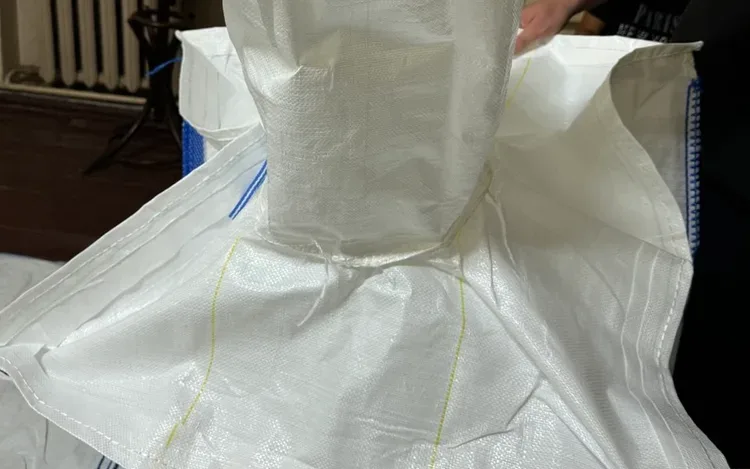
Fill evenly so the bag stands straight: a lopsided bag loads its loops unevenly during lifting. From a hopper or a pipe, fill through the top spout — without dust; from a bucket or a grab — into an open-top bag. To work out how many bags your batch needs, use the calculator: how many big bags you need per N tonnes.
Lifting by forklift and crane
The main rule: a bag is lifted by all its loops at once. Lifting by one or two of four loops overloads the seams — this is the most common cause of bag failures on site.
| Design | By forklift | By crane |
|---|---|---|
| 4-loop | Two loops on each fork | Spreader beam or a hook with four slings |
| 2-loop | Both loops onto the forks in one move | Only occasionally, via a spreader beam |
For regular crane work, use 4-loop bags: a four-point hitch is more stable. While lifting:
- ✔nobody stands under a raised bag or in its travel path;
- ✔lift and lower smoothly, without jerks or swinging: the safety margin exists precisely for such dynamic loads, and it should not be spent on every lift;
- ✔inspect the loops before each lift: a tear or delaminated webbing means the bag is taken out of service.
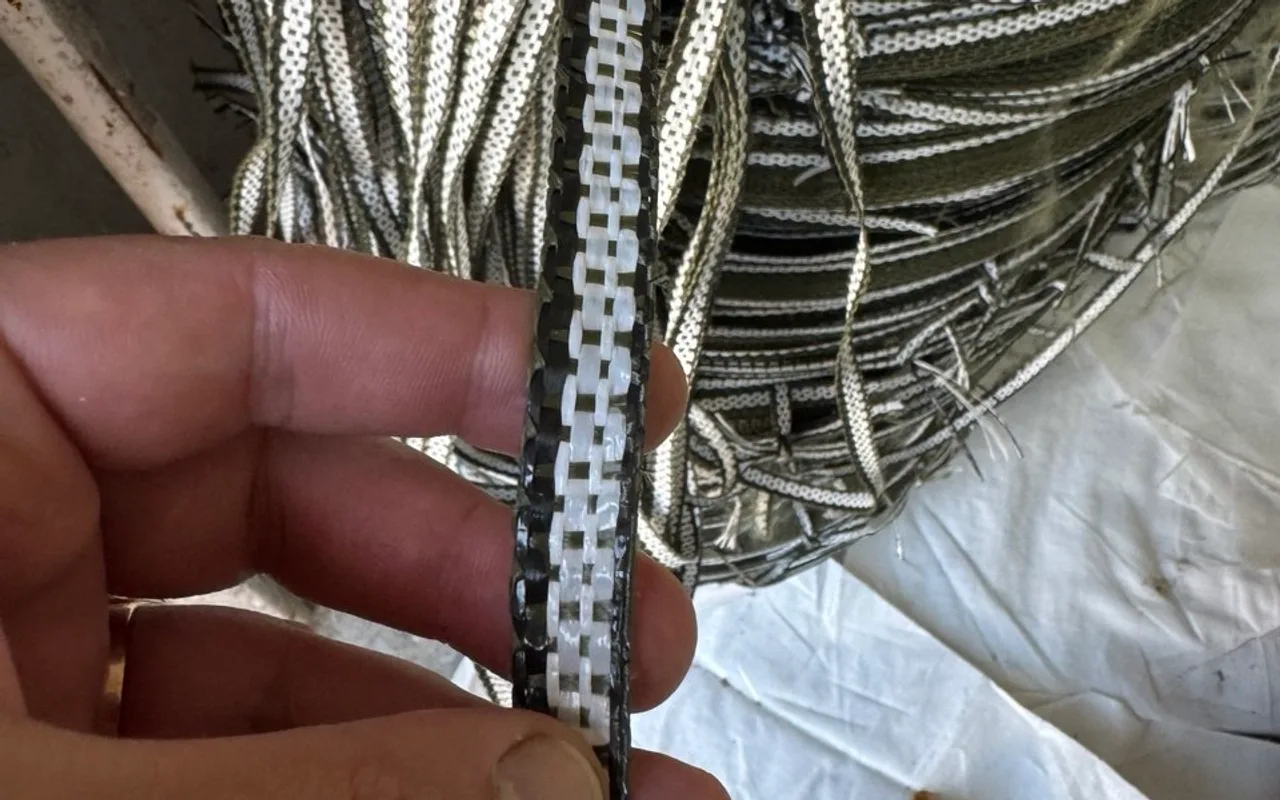
How to choose a design for your lifting method — see the 4-loop big bags and 2-loop big bags pages.
Transport: heavy bags in a single tier
Heavy big bags are not stacked in a vehicle: with loads of about a tonne every bag stands on the floor, and the number of bags is limited by the vehicle's payload rather than its floor area. A second tier is acceptable only for light loads and bags with a 6:1 safety factor. Figures for trucks, railcars and 20/40 ft containers are in the article how many big bags fit in a truck, railcar or container.
Storage: how many tiers you can stack
| Big bag | Tiers in storage |
|---|---|
| Single-trip, SF 5:1 | 1 |
| 2-loop | 1 |
| 4-loop, SF 6:1 | 2; a third only on a level, hard base |
Never stack more than three tiers. Bags go on pallets or a timber deck, not on bare ground or concrete, which draw moisture. Grain has its own requirements for moisture, liners and storage periods — see how to store grain in big bags.
Outdoor storage: why a bag weakens in the sun
Polypropylene without a UV stabiliser loses up to 50% of its strength after a season in the sun, and this cannot be seen from the outside. An open yard needs three things:
- ✔UV-stabilised fabric;
- ✔a top skirt — it keeps rain and snow out of the contents;
- ✔a polyethylene liner or lamination — for moisture-sensitive loads.
Even stabilised fabric degrades over time, so bags that stay outdoors for months are covered with a tarpaulin or kept under a canopy on pallets.
Discharging: a spout instead of a knife
The cleanest method is a bottom discharge spout: a sleeve 35–45 cm in diameter (40 cm as standard) with a tie. The bag is brought over the hopper and the sleeve is untied — free-flowing material runs out in a cone under its own weight; tie it back and the flow stops. Caked material, such as fertiliser after long storage, sometimes needs a little agitation by shaking the bag with the forklift. Reach the spout from the side, never stepping under the bag.
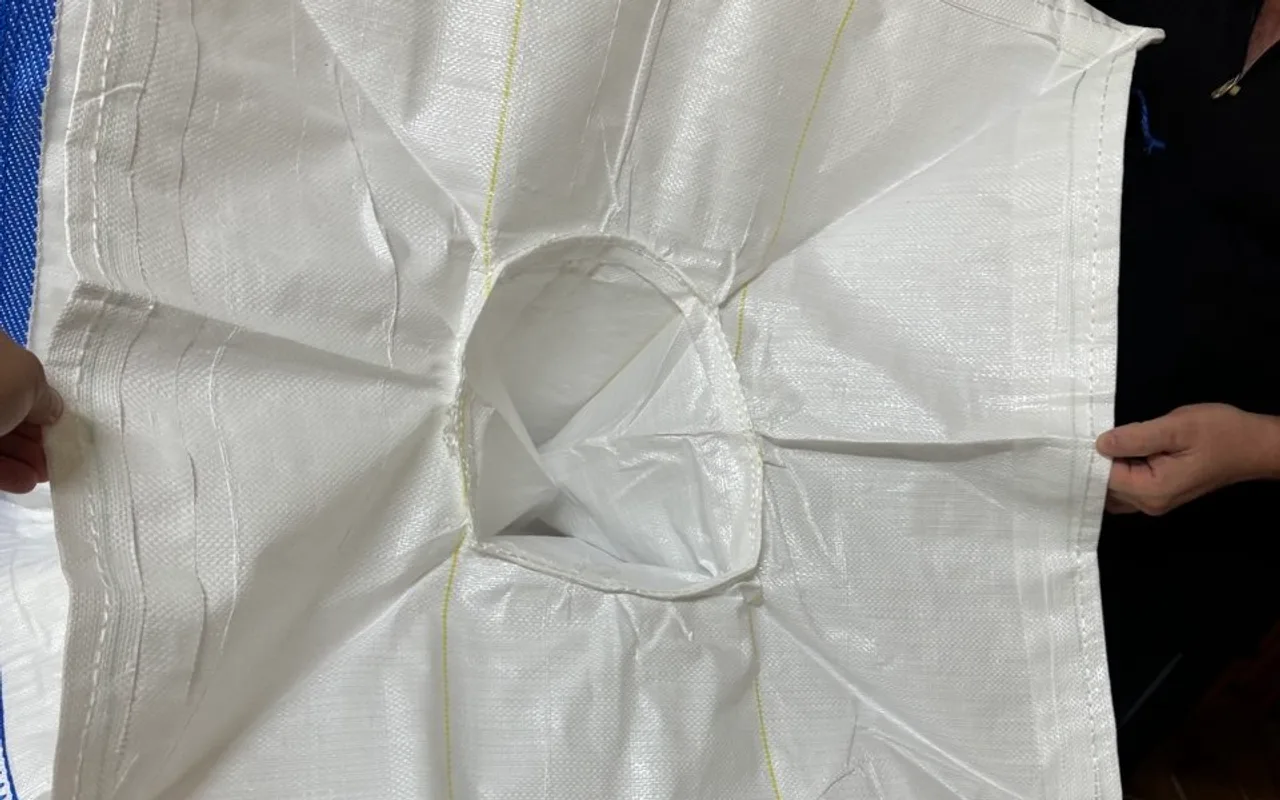
If the bag has a polyethylene liner, the liner's bottom sleeve is pulled out through the spout. Without a spout the bottom has to be cut open: discharging is dusty and wasteful, and the bag becomes unusable after its first trip. Bags with a bottom sleeve are listed under big bags with discharge spout.
Reuse: inspect before every cycle
Only bags with a 6:1 safety factor are reused: they are rated for 2–3 full cycles. Before every new filling, check:
- ✔loops — no tears or delaminated webbing;
- ✔body and bottom seams — no loose stitching;
- ✔fabric — no punctures or cuts;
- ✔spouts and ties — intact;
- ✔that no residue of the previous load is left inside.
A bag that spent a season in the sun without a UV stabiliser is not returned to service: its loss of strength is invisible. Food products and seeds go only into new bags with a liner. What a buyer of second-hand bags with an unknown history risks is explained on the used vs new big bags page.
Combustible powders: a separate requirement
For combustible powders and explosive atmospheres, big bags are classified as types A, B, C and D by their electrostatic properties (IEC 61340-4-4). The type for such a load is chosen separately, before ordering: the rules in this article apply to ordinary, non-explosive loads.
Checklist before every lift
- The load does not exceed the SWL on the label.
- The bag stands straight and the load is evenly distributed.
- Loops, seams and fabric are undamaged.
- All loops are engaged: two on each fork or through a spreader beam.
- Nobody is in the lifting zone.
- No more tiers than this model allows.
- The bottom spout stays tied until the bag is over the receiver.
UkrBagPak manufactures big bags with two and four loops, with 5:1 and 6:1 safety factors, with top filling and bottom discharge spouts and liners. Find a model for your lifting and storage method in the catalog: Buy big bags wholesale from the manufacturer.