


Big bags with discharge spout — unloading without cutting the bag
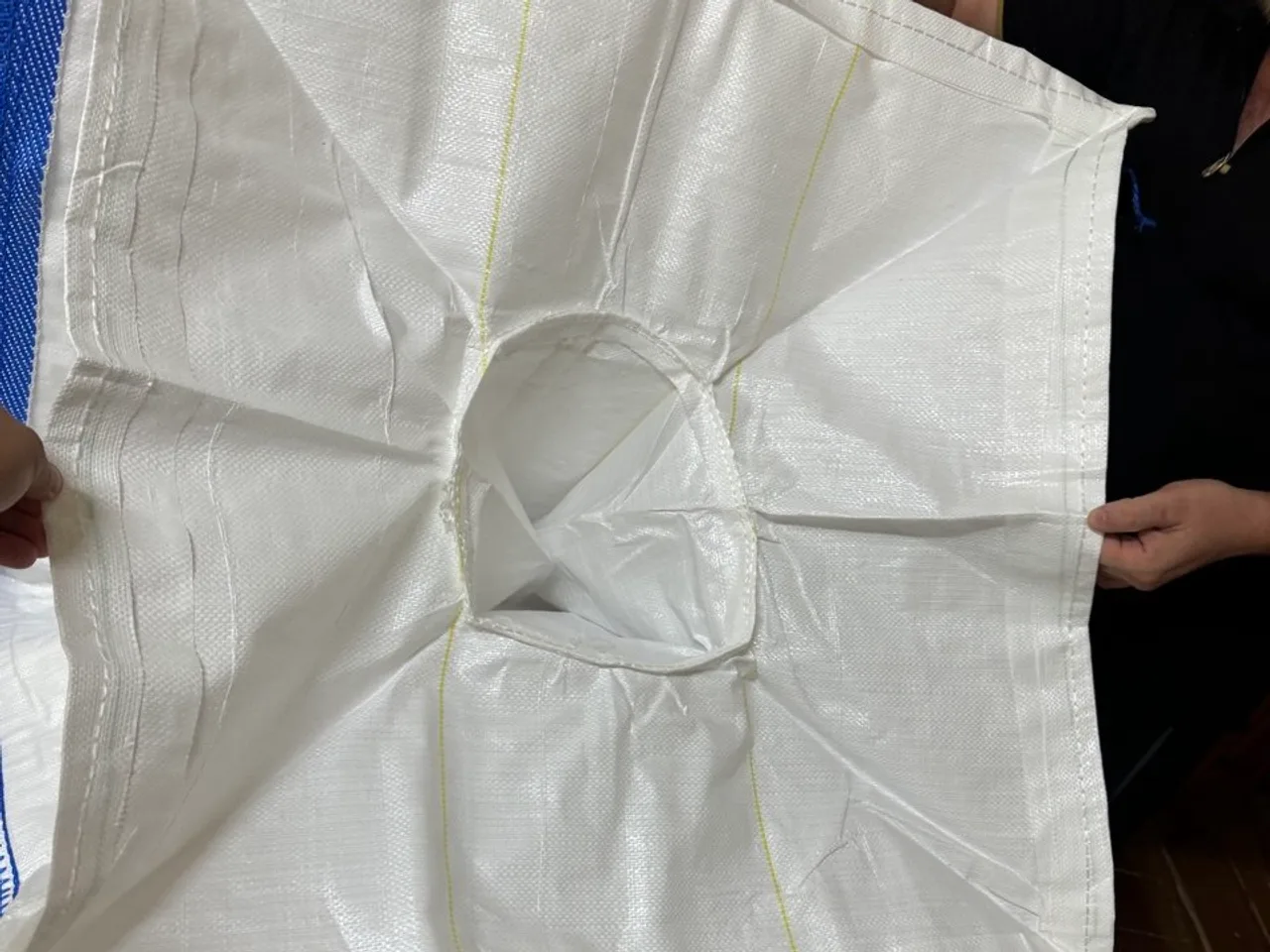
A discharge spout is a Ø35–45 cm sleeve in the bag's bottom: untie the ribbon and the cargo flows into the hopper in a cone, tie it back and the flow stops. The bag stays intact and, with a 6:1 safety factor, withstands 2–3 full cycles. It is the solution for anyone who empties bulk cargo into hoppers, augers, elevators or dosing units.
from UAH 200/pc
Leave your phone number — we'll calculate a price for your order and call you back
How the spout works
The standard spout is a sleeve 40 cm in diameter and 50–60 cm long with a ribbon tie; for coarse fractions we fit 45 cm or larger. The sleeve is covered by a protective skirt that guards it from damage in transit and accidental spillage.
The spout barely affects load capacity: the bottom is cut so the side seams and loops carry the load, just like a solid bottom.
Who needs a bottom spout
The rule is simple: if the cargo is poured out at the destination rather than the bag being handed over whole, you need a spout. Without one, the bottom gets cut open: the bag goes to waste after a single trip and unloading produces dust and product losses.
| Cargo | Where it is discharged via the spout |
|---|---|
| Grain, seeds | Elevator, grain thrower, receiving pit |
| Pellets, granules | Boiler hopper, screw conveyor |
| Mineral fertilizers | Spreader, blending unit |
| Construction mixes, cement | Dosing unit, mortar station |
| Compound feed | Feed mixer, dispenser hopper |
The top matters too
A bottom spout is usually combined with a filling skirt or a top spout: fill through the top, tie it, transport, discharge through the bottom sleeve — a full cycle without dust or spillage. For hygroscopic cargo a polyethylene liner is added: during unloading its sleeve is pulled out through the spout.
Price
A big bag with a discharge spout costs from UAH 200/pc: the spout adds little to the price and pays for itself from the second cycle by saving new packaging. Standard sizes ship from Zhytomyr in 1 working day. Minimum order — 50 pcs; free delivery for orders over 5,000 pcs.
Typical Sizes
| Name | Dimensions | Load Capacity | Tare Weight |
|---|---|---|---|
| Big bag 500 kg with spout | 75 × 75 × 100 cm | 500 kg | 1.7–2.2 kg |
| Big bag 1000 kg with spout | 90 × 90 × 130 cm | 1000 kg | 2.7–3.7 kg |
| Big bag 1500 kg with spout | 95 × 95 × 150 cm | 1500 kg | 3.7–4.7 kg |
* Sizes are approximate. We manufacture according to customer's custom dimensions.
FAQ
Does the cargo flow out of the spout by gravity?
Yes: free-flowing cargo pours in a cone under its own weight through the Ø40 cm sleeve. Caked materials (fertilizers after long storage) sometimes need light agitation of the bag with a forklift.
Which spout diameter should I choose?
The 40 cm standard covers most tasks — grain, pellets, fertilizers, mixes. For coarse fractions (crushed stone, coal, briquettes) we recommend 45 cm or more — we will advise for your cargo.
Can a spout be combined with a liner?
Yes, it is a typical combination for hygroscopic and food cargo: the liner protects from moisture, and during unloading its bottom sleeve is pulled out through the spout.
How many cycles does a spouted big bag withstand?
With a 6:1 safety factor — 2–3 full transport cycles, provided the bag is inspected before each use. Single-trip SF 5:1 bags are not rated for repeat runs.